
The Week One Declaration
I’m surprised I can even say it with a straight face. And yet, each time I repeat the pattern, I’m being sincere. It’s not a joke, even though I often chuckle at my own hubris in hindsight.
I call it the “week one declaration”.
In the initial days of a new practice or system, as soon as there is a hint of success, I declare victory.
- I’ve finally figured it out!
- This is amazing, and it will solve all my problems!
- Now this will definitely last.
When I say initial days, I mean it. Usually it’s day 2 or 3, but I’ve been known to shout from the rooftops on day one. Even though I know it’s too early to celebrate success, I can’t seem to help myself.
Perhaps you are not personally familiar with the week one declaration, but I’m guessing you know a few people who do this regularly. (Maybe you have trouble keeping a straight face when they tell you they’ve finally cracked the code.)
The pattern
These triumphant, yet premature celebrations often relate to persistent challenges, such as:
- health habits (morning routine, fitness plan, meal planning)
- productivity (new software or app, technique, system)
- organization (new product, process, system)
In my experience, the pattern looks and sounds a bit like this:
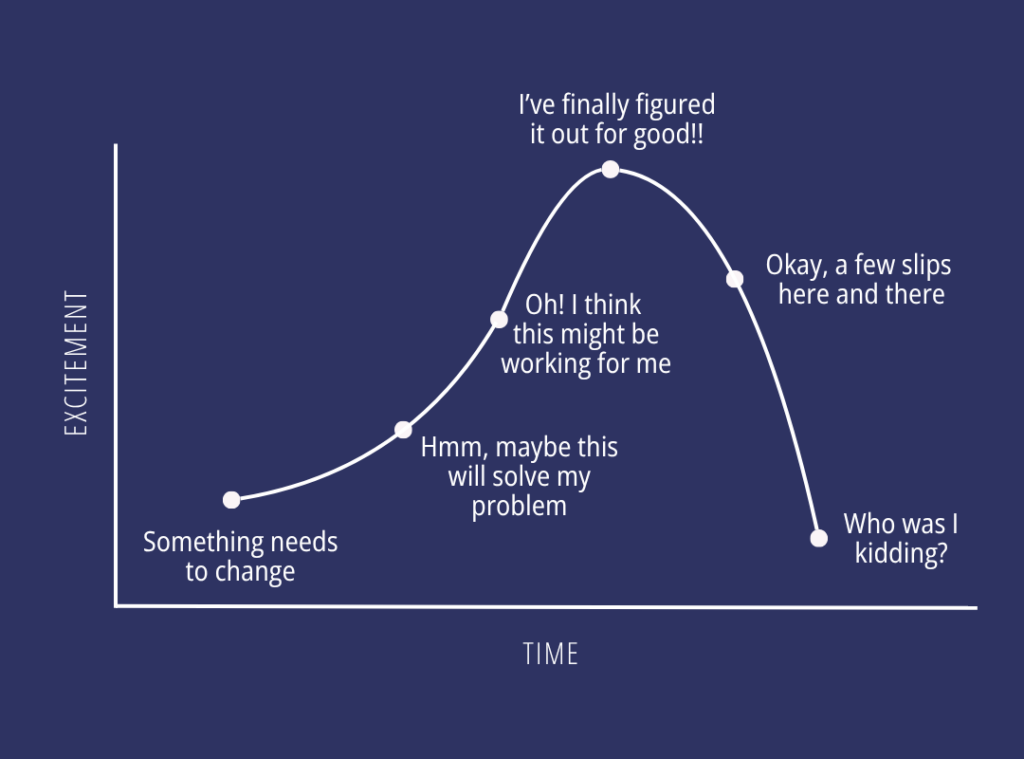
After deciding a change is needed, I discover a possible solution and excitement rises. With a little success, my excitement rises more until I hit the peak and make my way-too-early declaration.
A few days later, the cracks start to show and my excitement eases a bit, but I cling on to hope.
This is the inflection point.
In most cases, the trajectory is a sharp decline and I abandon the practice or system by the end of week two. I end up feeling worse than when I first decided something needed to change. I’m embarrassed I thought this time would be different and wish I didn’t tell everyone who would listen.
And yet, this pattern keeps happening for a reason.
Because sometimes it doesn’t end this way. Sometimes I do figure out what works, and it looks like this:
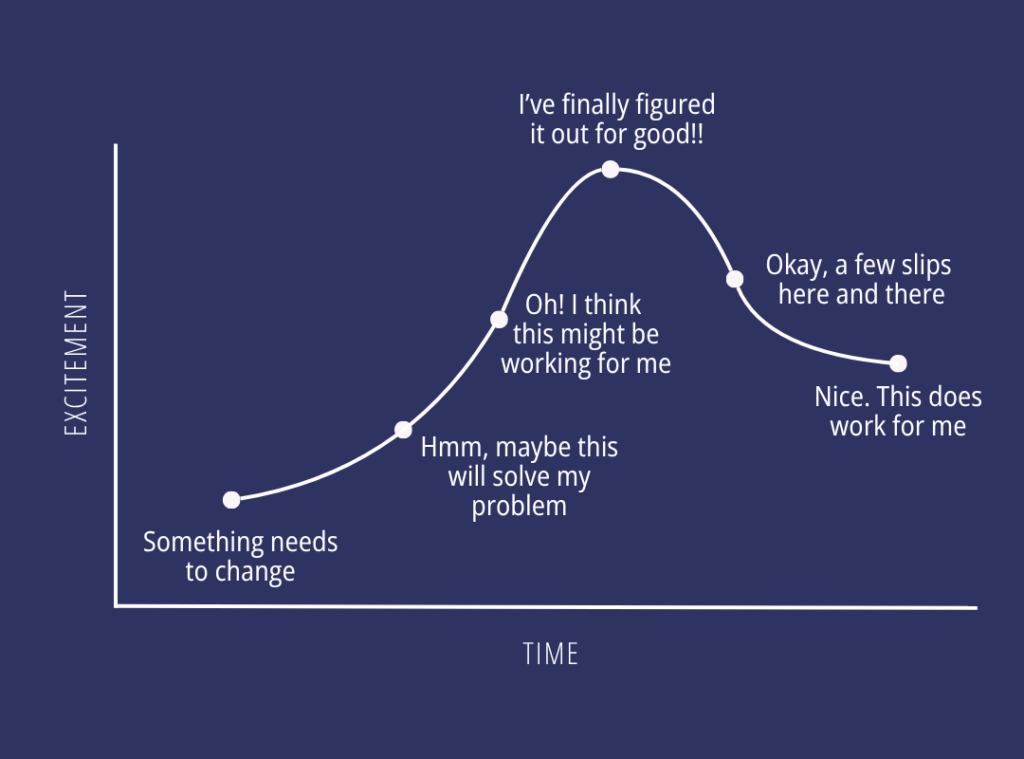
Instead of a sharp decline, I find a middle ground that suits me and becomes part of a regular practice or system. There are some minor adjustments along the way, but it works long-term.
Examples:
- The combination of Notion + Sunsama to organize my professional work
- Using Ecamm to record content and deliver live workshops and webinars
- My Sunday morning grocery shopping routine
- Using a ‘landline’ phone so I can keep my iPhone out of the bedroom without missing emergency calls (instead of paying for a separate landline, the phone connects to my cell via Bluetooth)
In each case, I was looking for a solution to a problem. As soon as it seemed like a great solution, I couldn’t help but share my excitement. But in these cases, I was correct. I had found a lasting solution that worked well for me.
What I’m trying to change
To be honest, I have no intention of stopping myself from making week one declarations. It’s how I’m wired. I’m an enthusiastic person who gets excited about possibilities, and I have no desire to squash or dim that part of me.
But what I do want to change is how I talk to myself when things don’t work out because that’s the part that causes harm. My inner critic is primed and ready to pounce when I’m proven wrong…again. I don’t know about you, but my inner critic is a condescending jerk. It sounds a bit like, “Oh, Cat. It’s adorable that you thought this time would be different.”
It’s not that I can prevent my inner critic from offering unhelpful commentaries, but I can choose how I respond when I notice it happening.
Instead of labelling a short-lived attempt as a failure, I can recognize it as an invitation to learn. It’s obvious something was resonating at first. So what was that? And then what was missing? Why didn’t this attempt last? What do I know now that I didn’t know before?
It’s all useful feedback I can use when I try again next time. And I will try again because an unsuccessful attempt doesn’t mean there’s no solution; it means I just haven’t found the solution that works for me yet.
Want to get these articles by email? Join the newsletter to stay up-to-date and get practical tips on follow-through.